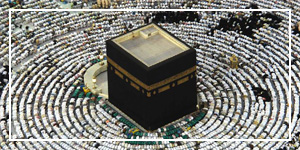
 When the blessed Prophet, peace and blessings be upon him, was thirty-five years old torrential floods caused the walls of al-Ka’ba to crack after a fire had already caused it much damage. The Quraysh intended to demolish and rebuild it as well as giving it a roof. The structure of al-Ka’ba used to be the height of a man and made up of dry-stone without mud or other adhesive.
The tribe of Quraysh gathered for this purpose but they were hesitant due to its sanctity in their hearts. Walīd b. Mughīra said to them: Do you intend to restore it or simply to destroy it? They replied: Of course, to restore it. He then began dismantling al-Ka’ba and the tribes followed suit. They continued until they came across the foundations laid by Isma’īl, peace be upon him, wherefrom they found documents containing many instructions. It was the norm for anyone who lay the foundations of a significant monument to leave instructions for latter generations so they could understand the work of their predecessors.
The construction began. Donations were collected for the work but no illicit or interest-generated wealth was permitted. The elders of the Quraysh would pick up the stones on their shoulders and amongst them was al-‘Abbās and the Messenger of Allah, peace and blessings be upon him. In charge of the project was Bāqūm, a Persian carpenter. Every corner of the building was designated to a group of elders who would oversee the transfer of stones to it. The pure funding fell short and they were unable to complete the refurbishment based on the foundations of Isma’īl, so they left out al-Ḩijr [1]. However, they erected a small wall over it to indicate that it was part of al-Ka’ba. When the building was complete it stood at 18 cubits – an increase from its original 9 cubits. The door was raised off the ground and was only accessible by ladder.
Now they wished to place The Black Stone, al-Ḩajr al-Aswad, in its place and the leaders began arguing over who should place it. Skirmishes broke out between them and it was close that a full-scale war would erupt. This argument lasted four nights until the eldest amongst the Quraysh at the time, uncle of Khālid b. Walīd, Abū Umayya b. Al-Mughīra al-Makhzūmī, said to them: “O people! Don’t squabble; leave the matter to someone who first enters (the mosque on the following morning).”
The first to enter was al-Amīn al-Māmūn, the Trustworthy, the Reliable, peace and blessings be upon him. All were content with his appointment as they knew of his reliability and truthfulness. They proclaimed: “This is the Truthful One, we agree upon Muhammad – the Praised One”; they would often settle their matters with him when nothing else would work.
When he was told of the matter he laid out his cloak, peace and blessings be upon him. Then instructed: “Let every tribe leader hold the edge of the cloth.” [2] He then placed on the cloth al-Ḩajr al-Aswad. He instructed them to raise the cloth to the appropriate level and he himself proceeded to place it in its place, peace and blessings be upon him. Thus a problem was averted – the kind that would often lead to major wars between the Arabs – were it not that Allah Almighty gave them an intellectual like Abū Umayya and a wise man like the Messenger, peace and blessings be upon him, to arbitrate between them in a manner which satisfied them all.
It was expected that the Quraysh would argue over this matter for al-Bayt, the House, was the focal point of the Arabs, where they would perform their pilgrimages. All matters pertaining to it were significant, worthy and honourable. It is the first place build for the worship as the blessed Quran testifies. Allah Almighty says in Surah Āl ‘Imrān:
إِنَّ أَوَّلَ بَيْتٍ وُضِعَ لِلنَّاسِ لَلَّذِي بِبَكَّةَ مُبَارَكًا وَهُدًى لِّلْعَالَمِينَ . فِيهِ آيَاتٌ بَيِّـنَاتٌ مَّقَامُ إِبْرَاهِيمَ وَمَن دَخَلَهُ كَانَ آمِنًا وَلِلّهِ عَلَى النَّاسِ حِجُّ الْبَيْتِ مَنِ اسْتَطَاعَ إِلَيْهِ سَبِيلاً وَمَن كَفَرَ فَإِنَّ الله غَنِيٌّ عَنِ الْعَالَمِينَ .
“The first House (of worship) appointed for men was that at Bakka: Full of blessing and of guidance for all kinds of beings: In it are Manifest Signs; the Station of Ibrahim; whoever enters it attains security; Pilgrimage thereto is a duty men owe to Allah- those who can afford the journey; but if any deny faith, Allah stands not in need of any of His creatures.” [3:96-97]
Its affairs were entrusted to the tribe of Jurhum after the family of Ismā’īl. But when they rebelled and oppressed those entering Makkah, the tribe of Khuzā’a fought them, banishing them from al-Bayt.
The tribe of Khuzā’a undertook its responsibilities for some time before the Quraysh took over at the time of Quşayy b. Kilāb. As a result it became a protected land. Arabs would pay homage to them with gifts. When they would seek its protection it would be a secure fort from the aggression of any assailant. Allah Almighty reminds them of this favour in His revelation, in Surah al-‘Ankabūt:
أَوَلَمْ يَرَوْا أَنَّا جَعَلْنَا حَرَمًا آمِنًا وَيُتَخَطَّفُ النَّاسُ مِنْ حَوْلِهِمْ أَفَبِالْبَاطِلِ يُؤْمِنُونَ وَبِنِعْمَةِ اللَّهِ يَكْفُرُونَ.
“Do they not then see that We have made a sanctuary secure, the while that men are being snatched away from all around them? Then, do they believe in that which is vain, and reject the Grace of Allah.” [29:67]
*[translator’s note] You can see a diagram of the inside of al-Ka’ba as it is today by clicking here. Also the following YouTube clip is interesting http://www.youtube.com/watch?v=IAeR1U0z5io
[1] Literally meaning lap (of the Ka’ba). It is currently referred to as al-Ḩatīm.
[2] Abū Nu’aym in ad-Dalāil (1/224/113-114); al-Ḩākim in al-Mustadrak (1/458); He says the report is true on the conditions of Saḩīḩ Muslim; Abū Dāwūd aţ-Ţiyālisī (2316); Ibn Sa’d in aţ-Ţabaqāt (1/145)’ Aḩmad and as-Suyūtī in al-Khaşāiş (1/224).

 Beacon of Certainty