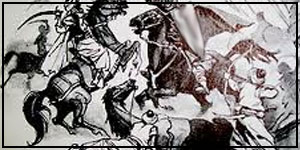
 When the Prophet, peace and blessings be upon him, was twenty years old the al-Fijār war broke out. It was a conflict between the tribe of Kināna aided by the Quraysh and the tribe of Qays. Its cause was the trading goods of the Arab king of al-Ḥīra [1], an-Nu’mān bin al-Mundhar. Every year he would send his goods to the markets of ‘Ukkāz [2]. He would normally send the goods in the trust of any of his kinsmen who was known for his honour and reputation. He was sitting one day in the company of both al-Brād bin Qays al-Kinānī, a murderer renounced and disowned by his people due to his immorality, and ‘Urwa bin ‘Utba a nomad.
The king, an-Nu’mān, asked: “Who will trade my goods for me till he reaches the market of ‘Ukkāz?” Al-Brād replied, “I will take them to the tribe of Kināna.” An-Nu’mān retorted, “I want someone to trade with all people!” ‘Urwa then mockingly offered, “Good riddance of a stray dog for it can’t be of use to you! I will trade on your behalf with the tribes of ash-Shayh, al-Qaysūm both of the Najd plateau [3]and also with the tribe of Tihāma [4].
Al-Brād enquired, “O ‘Urwa, will you also go to (my tribe of) Kināna?” He replied, “I will go to everyone.” Al-Brād took this to heart and lay in wait for him. When he set off with the trading goods, he murdered him and immediately sent a message to his people, the Kināna, warning about the retaliation of Qays, the tribe of ‘Urwa.
As for Qays, they did not wait for long to take revenge once they heard of what happened. Eventually they encountered both the Quraysh and Kināna at Nakhla [5] where they clashed. As the battle flared and the rage of Qays intensified, the Quraysh took to protecting their sacred lands. The Messenger of Allah, peace and blessings be upon him, was amongst the defenders. Then Qays called out to their adversaries, “We will not leave the blood of ‘Urwa unavenged so we will meet again at ‘Ukkāz next year.” Both groups then returned home whilst goading the other.
One year passed and Qays gathered their army amongst who were the Thaqīf along with others. Quraysh gathered their allies from Kināna and al-Ahābīsh. The Banū Hāshim were led by az-Zubayr bin ‘Abd ul-Muttalib. His brothers, Abū Tālib, Ḥamza and al-‘Abbās and his nephew the Noble Prophet, peace and blessings of Allah be upon him, were alongside him. Leading the Banū Umayya was Ḥarb bin Umayya. He was also the Commander-in-chief due to his age and status amongst the Quraysh. In a similar manner every family of the Quraysh had its divisional commander.
The battle raged and turned into one of the most horrific days for the Arabs not more so because of the sacrilegious events to befall the sacred land of Makkah, a land most honoured by all Arabs; so much so that they named it the Day of al-Fijār or immorality.
Qays’ defeat was close as many of its tribes had already been overwhelmed but negotiators from both sides pleaded for a truce. They agreed to count the fatalities of both sides. The side with the greater losses would take compensation from the other. Qays was found to have suffered most and so were to take compensation from the Quraysh. Ḥarb bin Umayya struck a deal with them and pawned his son Abū Sufyān as security for payment. Thus this war came to an end; a war which epitomised most Arab conflicts that would begin with the most trivial of matters. This remained until Allah Almighty united their hearts and cleansed them of this darkness by placing the shining beacon of Islam between them.
[1] An area west of the Euphrates which would be governed by an Arab king appointed by the Byzantines. It was conquered by Khalid bin Walid, Allah be pleased with him, in the year 12 Hijra.
[2] This was a trade market organised every year by the Arabs to boost their industries. Their intellectuals would sing its praise and it was unrivalled in its prestige in all the land. It was similar to the European trade fairs of today.
[3] The highlands of Arabia centrally situated.
[4] The low-lying shores of Arabia. The eastern shores are called al-Bahrayn. Moving West next is the area of Najd, al-Yamāma, al-Ḥijāz and then on the western shores lies Tihāma.
[5] An area between Makkah and at-Tāif.

 Beacon of Certainty